Bookkeeping, financial systems, job costing and management reporting — built so you can see what’s happening in your business while there’s still time to act.
Most business owners we meet already have bookkeeping. What they don’t have is a financial system that answers questions while there is still time to act on the answer.
Three connected stages. The structure comes first, the accounting keeps it true, and the reporting turns it into something you can run the business on.
We restructure QuickBooks Online around how your business actually operates — so the data lands in the right place from the start.
We keep it accurate every month, with a real close — not a bank feed that was categorized and left alone.
The structure and accounting work together to give you one thing: a clear view of where you’re making money, where you’re losing it, and what needs attention — while there’s still time to act.
This is the shape of the work, not the full scope — the detail depends on your business.
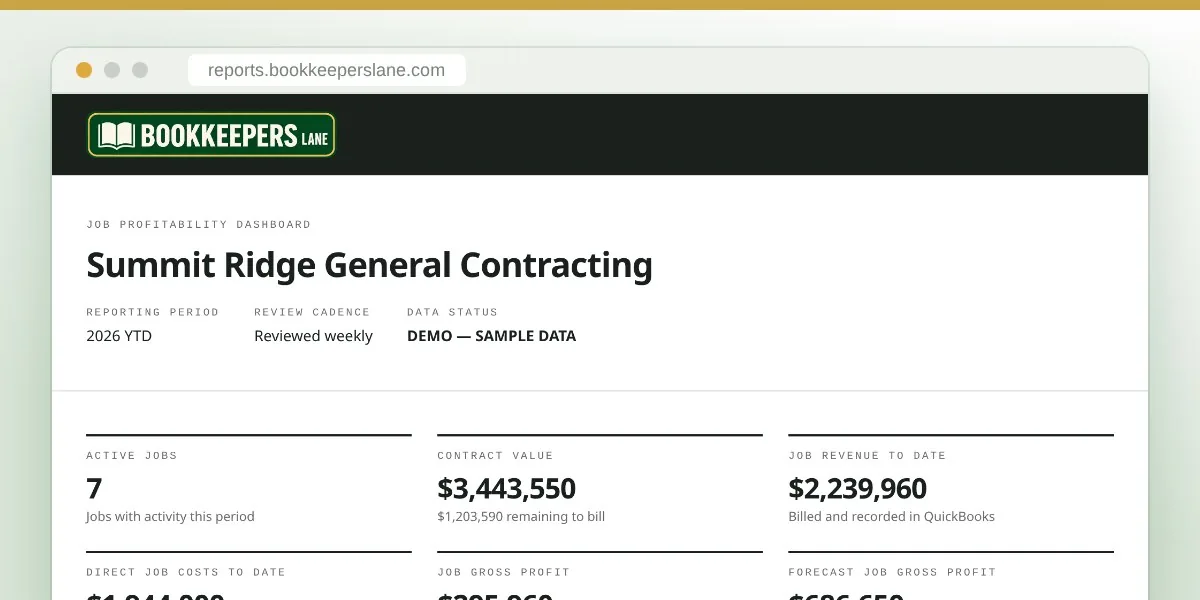
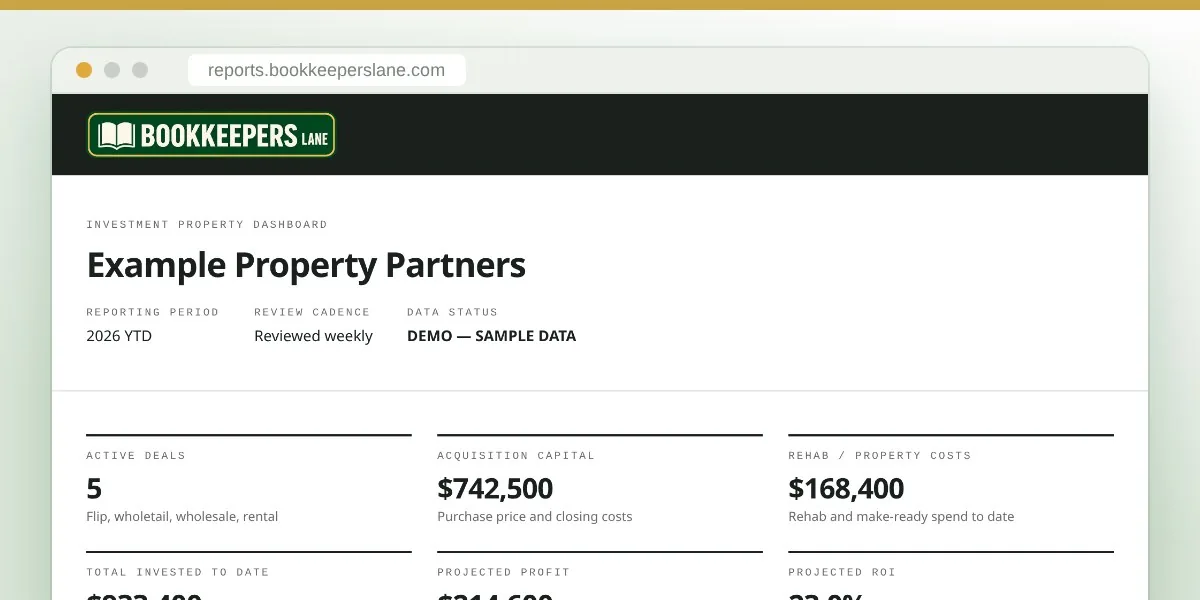
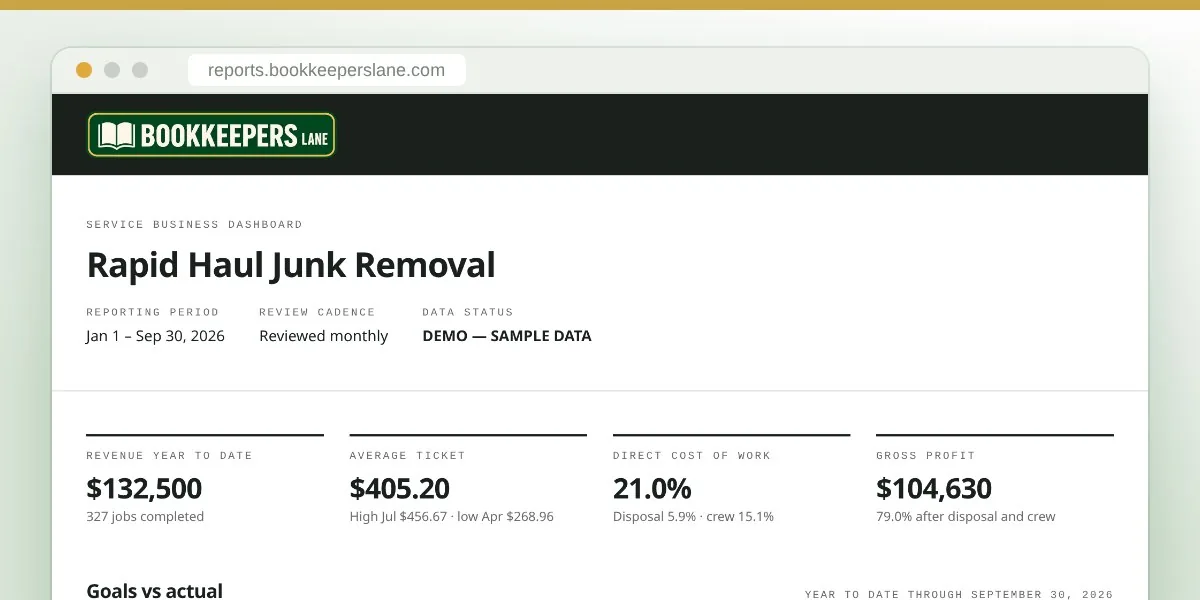
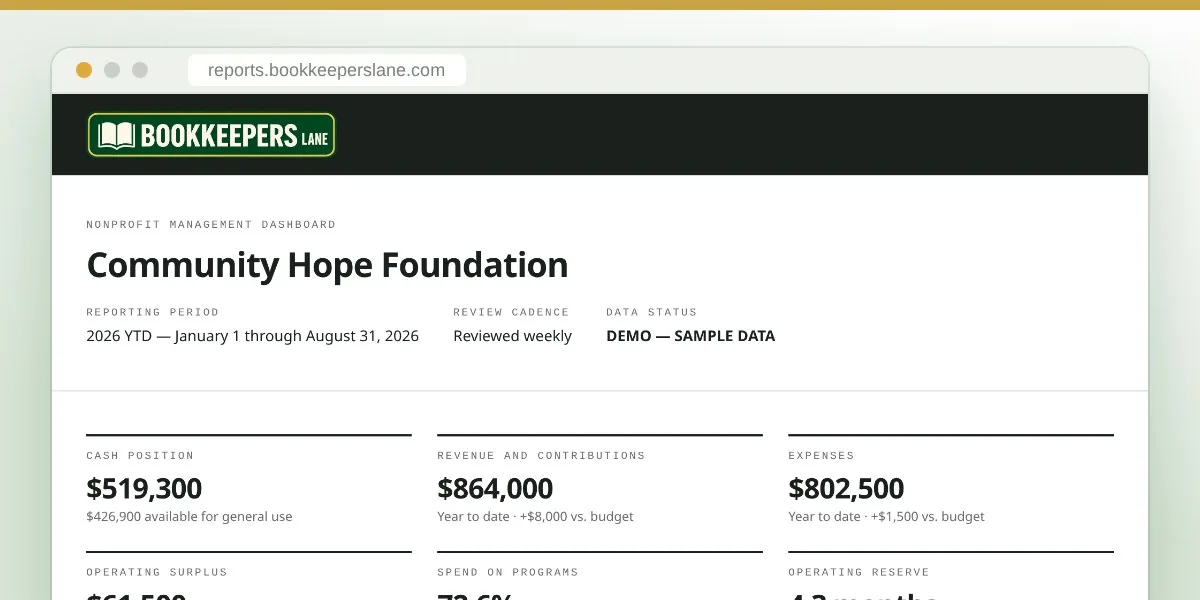
These are working reporting dashboards from our client portal, built on QuickBooks data. Open the one closest to your business and click through it.
Contract value, job revenue and costs, job gross profit, budget remaining and forecast profit — job by job.
Deal-level acquisition capital, rehab spend against budget, holding and financing costs, projected profit and ROI.
Cash position, restricted versus available funds, revenue by source against budget, program spend and operating reserve.
Demo dashboards use fictional companies and figures for illustration. Client dashboards read from the client’s own QuickBooks Online data.
Your operational software, your payroll provider, your bank and your accounting have to tell the same story. That connection is the work.
HVAC, plumbing, electrical, landscaping, cleaning and more — service-line and technician-level visibility instead of one lump of revenue.
Job costing, draws, retainage and WIP, so you know where each project stands before it closes.
High job volume, insurance timing and supplements — tracked per job so margin is visible while the job is still open.
From single-family rentals to multi-entity portfolios: property-level reporting, CapEx tracking and loan oversight.
Restricted versus unrestricted funds, program and grant reporting, and budget-to-actual your board can read.
These are the industries we know best, but the approach travels. If your business has jobs, projects, properties or locations to account for, let’s talk.
Ongoing categorization, reconciliations and a structured month-end close, with the balance sheet reviewed rather than assumed.
Bringing behind or unreliable books current — reconciling accounts, correcting coding, and fixing the structural issues that caused the mess.
Chart of accounts, customers and jobs, classes, locations and items designed around your operation, plus the workflows and app connections that feed it.
Direct costs tied to the job that incurred them — labor, materials, subs — so job gross profit is a real number and not an estimate.
Management reporting and an interactive dashboard: profitability by job, customer, location and service line, AR/AP aging, cash-flow visibility and WIP.
Working through what the numbers are showing — margin pressure, pricing, cash timing, where the structure needs to change next.
Real accounting judgment behind the work, not data entry.
We work in QBO every day, including the parts most people never touch.
We keep current on QuickBooks, the app ecosystem and accounting practice.
A defined close process, repeated the same way every month.
Reporting shaped to your business, not a default P&L export.
We build the connections between your systems instead of working around them.
We carry business insurance for the work we do.
Every close is reviewed by a person who understands your business.
Bookkeepers Lane is a family firm, led by Caroline Brown and her son Lucas. We work with contractors, investors and nonprofits whose businesses are big enough that the financial detail matters — and complicated enough that generic bookkeeping stops being useful.
Every engagement starts with a Books Review: a deep look at your current books and QuickBooks structure showing what is working, what is not, and what to do next. It is the fastest way for both of us to see whether we are a fit.
Start with a conversation. We will look at how your business runs, how your books are structured today, and what it would take to give you reporting you would actually use.
Tell us what you’re dealing with and we’ll get back to you personally — usually the same business day.